
Environment
Responding to Climate Change
Basic Approach
The Yokowo Group is committed to climate action, selecting "Environment" as one of its material issues (materiality) and also setting a target for reducing greenhouse gas (GHG) emissions (Scope 1 & 2)*1 in its Environmental Policy and Action Guidelines.
The Group discloses these concrete measures and progress in their implementation in the CDP (Carbon Disclosure Project) framework, and will also put more effort into reducing Scope 3 greenhouse gas emissions in the future.
The Yokowo Group has used third-party assurance services to validate its total GHG emissions data since FY2019, and has disclosed its total GHG emissions and climate change initiatives to CDP since FY2017. Going forward, the Group will continue strongly promoting action on climate change in pursuit of achieving carbon neutrality by 2050 and will continue contributing to the development of society through its business activities.
*1 Reducing greenhouse gas emissions from its own plants (Scope 1 & 2) by 35% by FY2030, compared to FY2014
Governance
The YOKOWO Group recognizes climate change as one of its key management issues.
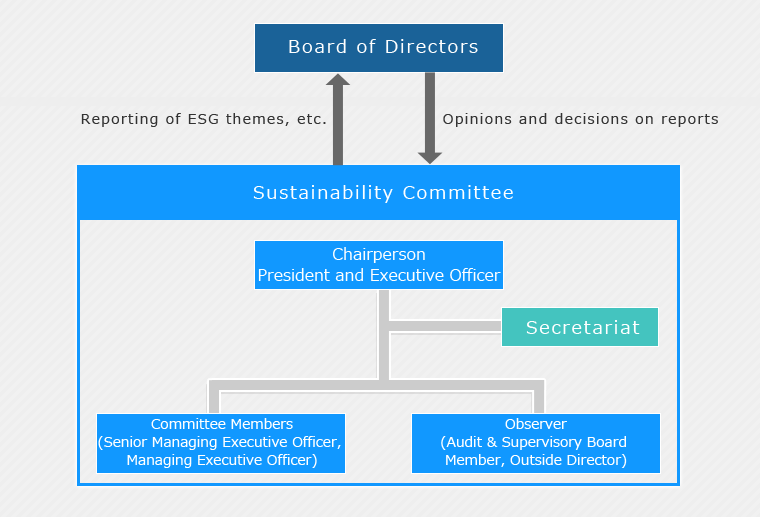
Under the oversight of the Board of Directors, we have established the Sustainability Committee to discuss and deliberate on policies, key issues, and business opportunities and risks related to climate change. The President and Chief Operating Officer is responsible for allocating resources to climate-related policies and initiatives.
The Sustainability Committee is chaired by the President and COO and is composed of Executive Officers (Senior Managing Executive Officer and Managing Executive Officer) as committee members, with the Full-time Audit & Supervisory Board Member and Outside Directors serving as observers.
The Committee reviews and discusses sustainability-related policies, strategies, and material issues, including climate change initiatives, and monitors and evaluates progress toward materiality and KPI targets. Its proposals and reports are submitted to the Board of Directors.
We have also incorporated performance evaluations related to climate change initiatives into the criteria for determining compensation for Directors and Executive Officers. The President and COO conducts the initial evaluation, which is then submitted to the Nomination and Compensation Advisory Committee—where a majority of the members are Independent Outside Directors—for deliberation. The committee chair, an Independent Outside Director, submits the finalized proposal to the Board of Directors for approval.
Sustainability Committee Framework
Major Initiatives
Scenario Analysis
Yokowo conducted a scenario analysis based on the Group's three segments (Vehicle Communication Equipment, Circuit Testing Connector and Personal Communication Equipment), to identify and evaluate climate-related risks and opportunities and understand the medium- to long-term impact of climate-related challenges on businesses. For the analysis, Yokowo used a scenario which anticipates a global temperature increase of 3℃ compared to pre-industrial revolution by 2100 as well as a scenario which anticipates that the global temperature increase is kept below 1.5℃, and analyzed transition risks and opportunities as well as material changes due to disasters, etc. (material risks and opportunities).
Impact on the Yokowo Group's Businesses
| Strategies and areas impacted | Explanation of impact |
|---|---|
| Products and services | The Yokowo Group’s core products and services are manufactured and sold across three segments: in-vehicle communication devices, connectors for circuit testing, connectors for electronic equipment, and medical devices. In the manufacturing industry, design and production are the primary business activities; however, initiatives to reduce GHG emissions during the production phase—where emissions are most significant—are critically important. Starting in fiscal year 2026, emissions trading will be introduced for large-scale emitters, and from fiscal year 2028, carbon charges will be imposed on fossil fuel businesses. Furthermore, the EU will fully implement CBAM from fiscal year 2026, and companies are expected to face strong requirements for substantial GHG reductions. Accordingly, it is essential for our Group to develop and supply products with lower GHG emissions, making the enhancement of our technological proposal capabilities and competitiveness more important than ever. |
| Supply chains and/or value chains | The Yokowo Group’s supply chain and value chain can broadly be divided into two categories: the production and procurement of materials that make up our products (such as raw materials and secondary products), and the manufacturing activities at our own production facilities. Starting in fiscal year 2026, emissions trading will be introduced for large-scale emitters, and from fiscal year 2028, carbon charges will be imposed on fossil fuel businesses. Furthermore, the EU will fully implement CBAM from fiscal year 2026, and companies are expected to face strong requirements for substantial GHG reductions. While our company will not be directly subject to these regulations, we anticipate indirect impacts through rising costs of raw materials and electricity, which are likely to increase overall expenses. |
| R&D investment | The Yokowo Group aims to constantly develop and supply cutting-edge products in all three segments (Vehicle Communication Equipment, Circuit Testing Connector and Personal Communication Equipment), and the development of technologies and R&D are extremely important for business growth. The Group has to reduce GHG emissions in accordance with the national policy in the 2015 Paris Agreement as well as other laws and regulations, which also means it is essential to develop and possess technologies to achieve such reductions. More specifically, the development of technologies for carbon neutral production and carbon neutral products are issues which need to be addressed. |
| Operation | In the Vehicle Communication Equipment and Circuit Testing Connector and Personal Communication Equipment businesses, which are the Yokowo Group's core businesses, production processes at plants are major sources of GHG emissions and the societal trend towards decarbonization poses various operational risks and opportunities, including carbon taxes, renewable energy introduction and pricing. In light of such risks and opportunities, the Group is implementing specific measures with the target of reducing greenhouse gas emissions from its own plants (Scope 1 & 2) by 35% by FY2030, compared to FY2014, and the reduction of emissions associated with plant operations is an important issue to be addressed. |
| Elements of financial plans impacted | Explanation of impact |
|---|---|
| Assets | The results of scenario analysis indicated that assets will be impacted, with higher prices for transactions due to the need for enhanced energy saving performance on the construction of new buildings or the selection of offices based on recognition of the urgency of complying with low-carbon and decarbonization requirements. Other assets such as production facilities and their ancillary facilities, plant infrastructure and equipment and company cars (BEVs, HEVs, rapid chargers) will also be similarly impacted. |
Risk Management
The Yokowo Group operates in four business segments: in-vehicle communication devices, connectors for circuit testing, connectors for electronic equipment and medical devices, and the Incubation Center. Among these, we identify and quantify the risks and opportunities related to corporate activities and behaviors—including those associated with climate change—across our three core segments, and manage them accordingly.
The identification and assessment of climate-related risks are conducted as part of the operational process of the Environmental Management Committee, which is chaired by the Sustainability Promotion Department. This includes regular annual evaluations and ad hoc assessments as needed. Each department represented on the committee identifies climate-related risks within its respective business processes and performs risk assessments. The committee secretariat then consolidates these findings, determines company-wide risks, and reports them to the Board of Directors after obtaining approval from the Head of Sustainability Promotion and the executive officer responsible for environmental matters.
Introduction of Renewable Energy Sources
The Yokowo Group is seeking to realize proposed plans for the introduction of renewable energy sources at its plants in Japan (Tomioka, Gunma), China, Vietnam and Malaysia, aiming for direct reduction in greenhouse gas (GHG) emissions.
Installation of a solar power generation system
The Yokowo Group is advancing plans to introduce renewable energy at its major production sites in Japan (Tomioka City, Gunma Prefecture), China, Vietnam, and Malaysia to reduce direct greenhouse gas (GHG) emissions. In October 2022, we installed a solar power generation system at our Vietnam plant under Japan’s Joint Crediting Mechanism (JCM), achieving an annual power generation of approximately 1.34 million kWh. Subsequently, in June 2023, a system was introduced at the Tomioka plant (approx. 380,000 kWh), followed by the China plant in June 2024 (approx. 1.7 million kWh).
Water Risk Management
Yokowo defines factories located in regions rated as “Extremely High” or “High” by the WRI Aqueduct Water Risk Atlas as water-stressed facilities. In our 2024 assessment, we confirmed that Lumax YOKOWO Technologies Pvt. Ltd., an equity-method affiliate, faces a high risk of water scarcity.
Targets
The Yokowo Group has set itself a target of reducing greenhouse gas (GHG) emissions (Scope 1 & 2) by 35% by FY2030, compared to FY2014, in pursuit of the achievement of carbon neutrality by 2050.
Going forward, the Yokowo Group will continue to accelerate initiatives for achievement of the target, focusing on areas such as expansion in the share of electricity generated from renewable energy, reduction of energy intensity, introduction of renewable energy self-consumption systems, and green energy procurement, and the Group will also put more effort into reducing Scope 3 greenhouse gas emissions.
(For a breakdown of GHG emissions by category, please refer to the Group's ESG Data)
| GHG Emissions (Unit : t-CO2) |
Period | ||
|---|---|---|---|
| FY2014 (Results) | FY2024 (Results) | FY2030 (Target) | |
| Scope1 | 402 | 967 | 35% reduction from FY 2014 (Scope1・Scope2) |
| Scope2 | 18,009 | 20,155 | |
| Scope3 | - | 209,564 | |
| Total emissions (Scope1・Scope2) |
18,411 | 21,122 | |
Performance
- 100% Renewable Electricity at Tomioka Plant
- Introduction of Solar Power Generation
- Third-Party Assurance for GHG Emissions and Energy Consumption
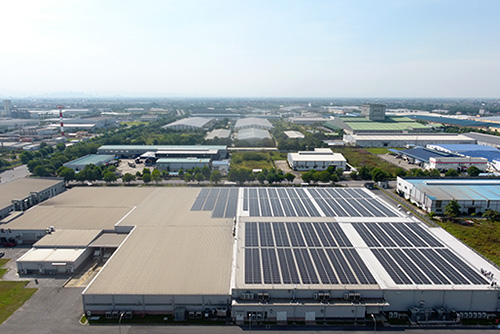
2022: Vietnam Plant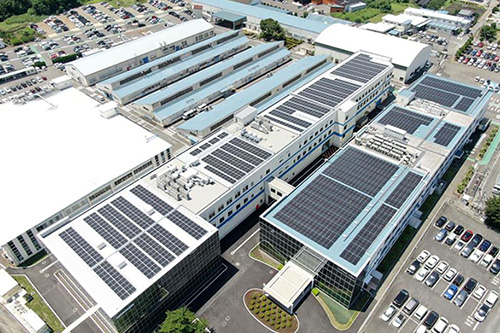 2023: Tomioka Plant
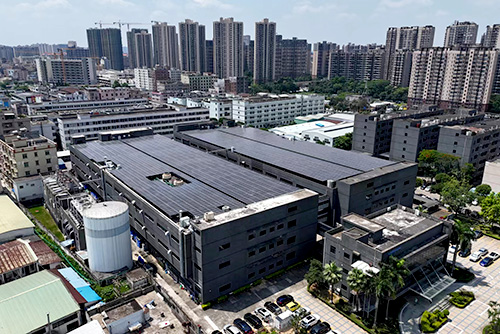 2024: China Plant
The Yokowo Group has implemented a GHG (Greenhouse Gas) management system and calculates emissions for Scope 1, 2, and 3. We will continue to ensure data accuracy while promoting more timely disclosure of information.
Please refer to the ESG Data Book for detailed results of each initiative.
For Climate-related KPIs, please refer to Sustainability Management.