
Social
Respect for Human Rights
Yokowo Group is driven by our Purpose to “Be a good company by employing people and technologies that work for the benefit of society today and tomorrow.” While listening to the diverse voices of our colleagues and seeking guidance from around the world, we work together with our stakeholders, which include our employees and their families, our customers and business partners, and local communities. We envision a better and more prosperous future, aiming to take on the challenge of creating something new to achieve our goals.
The Yokowo Group Human Rights Policy (“this policy”), as a basis for our Purpose, sets forth our approach and responsibility to respect the human rights of stakeholders with whom we are involved through our business activities. This policy governs all other policies related to human rights within the Group and stands as a guiding principle of our continuous human rights efforts.
This policy was approved by the Board of Directors of YOKOWO Co., Ltd. in October 2025.
Revised on October 22, 2025
Yokowo Co., Ltd.
YOKOWO Group Human Rights Policy
1. Fundamental Approach to Human Rights
We recognize that our business activities may directly or indirectly impact human rights. In accordance with internationally recognized human rights norms, we take proactive responsibility to respect and protect the human rights of all stakeholders through prevention, remedy, dialogue, and education.
Compliance with Laws and Respect for International Norms
We respect human rights as set out in the International Bill of Human Rights and the International Labour Organization (ILO)’s Declaration on Fundamental Principles and Rights at Work. We also support the United Nations Guiding Principles on Business and Human Rights and the OECD Guidelines for Multinational Enterprises.
We comply with the laws and regulations in the countries and regions where we conduct our business activities. Where the laws and regulations of a country or region conflict with international norms, we will seek ways to respect internationally recognized human rights to the greatest extent possible.
Scope of Application and Expectations for Business Partners
This policy applies to all officers and employees—including contract employees and temporary staff—of the Yokowo Group, which consists of Yokowo Co., Ltd. and its consolidated subsidiaries.
We also expect our business partners to understand and comply with the human rights norms and principles expressed in this policy. We will promote mutual understanding and cooperation through dialogue to advance human rights initiatives together.
Governance Structure
The Human Rights, Labor, and Ethics Management Committee is responsible for overseeing the implementation of this policy and addressing significant risks. The Board of Directors supervises these activities.
2. Human Rights Due Diligence
Continuous Implementation of Human Rights Due Diligence
In line with the United Nations Guiding Principles on Business and Human Rights, we work to identify, prevent, and mitigate adverse human rights impacts through the establishment of a human rights due diligence process, which includes monitoring and the disclosure of relevant information.
Dialogue with Stakeholders
We engage in ongoing dialogue and consultation with internal and external stakeholders to understand and address actual or potential adverse human rights impacts arising from our business activities.
Training and Education
We provide continuous training to our officers and employees to ensure understanding and implementation of this policy.
Disclosure
As part of our human rights due diligence process, we disclose progress on our human rights initiatives in a timely and appropriate manner.
3. Remediation
If it becomes evident that our business activities have caused or contributed to adverse human rights impacts, we will take appropriate measures to remediate the situation and provide remedy to affected individuals, utilizing grievance mechanisms and stakeholder dialogue.
4. Priority Human Rights Issues
Based on regular human rights impact assessments, we identify and address priority human rights issues for the Yokowo Group. These priorities may be revised flexibly in response to changes in social conditions and the business operating context.
Appendix : Priority Human Rights Issues (as of September 2025)
- Human Rights Issues in YOKOWO Group
- Access to remedy
Gender equality
Harassment
Employment conditions for foreign workers
Systems that promote meaningful work
Impacts on mental and physical health - Human Rights Issues in supplier operations
- Inadequate labor standards and compliance processes
- Human Rights Issues in YOKOWO Group
- Human rights risks related to raw material sourcing from conflict-affected areas
Forced labor
Human Rights Impact Assessment
Purpose of Human Rights Impact Assessment
The Yokowo Group is committed to the continuous practice of respecting human rights, based on our corporate philosophy and the YOKOWO Group Human Rights Policy. As part of these efforts, we conduct “Human Rights Impact Assessments” to visualize and identify potential negative impacts on human rights arising from our business activities, and to implement measures to mitigate such impacts. Through this process, the Yokowo group aims to enhance the effectiveness and transparency of human rights due diligence, and to continuously reduce adverse human rights impacts associated with our operations.
Methodology of Human Rights Impact Assessment
The selection of assessment items for this Human Rights Impact Assessment is based on key human rights issues and guidelines indicated by major international and domestic frameworks1, as well as the results of self-assessment surveys conducted with the Yokowo Group and our primary suppliers, who account for approximately 90% of our domestic transaction volume.
Additionally, with support from the independent organization CSO Network2, we have incorporated expert advice to identify assessment items that reflect the characteristics and value chain risks of the electronic components manufacturing industry. Past internal whistleblowing cases have also been considered, and priority has been evaluated based on the degree of involvement and severity (scale, scope, and difficulty of remediation).
- United Nations Guiding Principles on Business and Human Rights (UNGPs), OECD Guidelines for Multinational Enterprises, ILO International Labor Standards, and the Ministry of Economy, Trade and Industry’s “Reference Materials for Respecting Human Rights in Responsible Supply Chains,” among others.
- CSO Network is a non-profit think tank that works toward a fair and sustainable society by collaborating with businesses, government, and communities to address real-world challenges through dialogue and participation.
Human Rights Impact Assessment

| Identified Human Rights Issues |
|---|
| Human rights issues identified through questionnaires and internal cases within the Yokowo Group |
| Access to Remedy |
| Gender Equality |
| Employment of Persons with Disabilities |
| Employment Conditions of Foreign Workers |
| Harassment |
| Impacts on Physical and Mental Health |
| Protection of Privacy |
| Working Conditions |
| Freedom of Association and the Right to Collective Bargaining |
| Equal Pay for Equal Work |
| Human rights issues identified through self-assessment questionnaires conducted with business partners |
| Lack of Labor Standards and Legal Compliance Processes |
| Working Environment of Foreign Workers |
| Access to Remedy |
| Working Conditions |
| Human rights issues common across the supply chain, including the Yokowo Group and its business partners |
| Involvement in Human Rights Violations in Conflict-Affected Areas |
| Forced Labor |
| Child Labor |
| Occupational Health and Safety |
Future Approach to Human Rights Impact Assessment
Going forward, we plan to progressively review the assessment items in line with the expansion of the survey scope and the refinement of assessment granularity. Specifically, we will add, consolidate, and redefine items based on changes in the external environment and social expectations, as well as issues identified through our ongoing human rights due diligence efforts.
The next review is planned to be conducted in conjunction with the revision of the Human Rights Policy, reflecting the results of self-assessment questionnaires from suppliers newly included in the scope during the current fiscal year.
Thereafter, we will implement continuous and systematic updates in alignment with the materiality review schedule.
Framework
Based on the United Nations Guiding Principles on Business and Human Rights, the Yokowo Group identifies, prevents and reduces the negative impact of its business activities on human rights, evaluates the effectiveness of its efforts and strengthens its system for explaining and disclosing information about how the Group has addressed human rights issues. The Human Rights, Labor Ethics Management Committee, which was established in 2022, plays a central role in important measures regarding human rights and ethics. It deliberates on these matters and works to build a human rights due diligence system and address individual human rights issues in cooperation with domestic and overseas subsidiaries and related divisions.
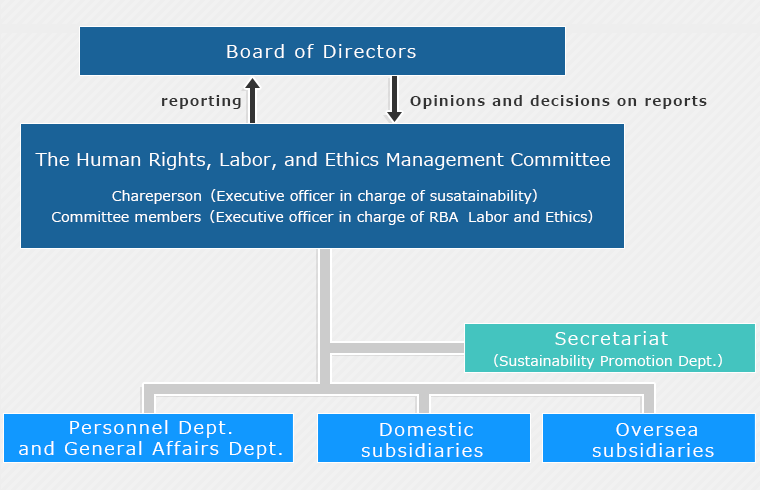
Addressing the RBA Code of Conduct to Support Our Human Rights Policy Commitment
Efforts to address Individual Human Rights Issues in Yokowo Group Human Rights Policy
| Human Rights Issues | Yokowo Group Initiatives |
|---|---|
| Prohibition of Forced Labor | Conclusion of tri-partite contracts with sending and receiving organizations to prevent workers from paying fees |
| Prohibition of Child Labor | Establishment of Child Labor Remedy Regulations Enhancement of the age verification process |
| Prohibition of Discrimination | Establishment of Contact for ethics and human rights concerns |
| Prohibition of Inhumane Treatment | Furnished prayer rooms・Providing Halal Food |
| Freedom of Association and the Right to Collective Bargaining | Collective bargaining agreements |
| Working Hours and Wages | Addressing Unreasonable Treatment Differences in Equal Pay for Equal Work |
| Occupational Health and Safety | Mandatory provision of safety equipment Implementation of health tests and stress checks |
| Rights of Foreign Migrant Workers | Conducted interviews with Vietnamese technical intern trainees and specified skilled workers regarding the working environment with the cooperation of NGO groups. |
Training Results regarding Human Rights Policy
- 【Training】
-
- Human Rights Issues Relevant to Our Business
- Prohibition of Forced Labor
- Prohibition of Child Labor
- Prohibition of Discrimination
- Prohibition of Inhumane Treatment
- Freedom of Association and the Right to Collective Bargaining
- Working Hours and Wages
- Occupational Health and Safety
- Rights of Foreign Migrant Workers
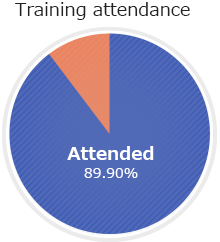
Tiered Human Rights Management Training
The Yokowo Group conducts human rights management training with the aim of promoting understanding and practical implementation of the UN Guiding Principles on Business and Human Rights and the Company’s Human Rights Policy.
In fiscal year 2025, the training was provided to the President, Executive Officers, Presidents of subsidiaries, and Department Managers, achieving a 100% participation rate among eligible participants.
In fiscal year 2026, the scope of the training will be further expanded to include all levels of management, down to section managers, and the program will be rolled out accordingly.
| Item | Description |
|---|---|
| raining Program Name | Tiered Human Rights Management Training |
| FY2025 Participants | President, Executive Officers, Department Managers (JYC), and Heads of Overseas Locations |
| Purpose of the Training | Understanding of the Human Rights Policy and Its Integration into Management Practices |
| Participation Rate | 100% |
Results
Yokowo Group's Human Rights Due Diligence
| Processing of Yokowo Group's Human Rights Due Diligence | Measures | FY2025 Performance |
|---|---|---|
| 1.dentification of risks | Selection of material issues (based on the RBA Code of Conduct) Implementation of SAQ |
Implementation of Human Rights Impact Mapping RBA VAP Audit Participation Implementation of Supplier SAQs (Self-Assessment Questionnaires) |
| 2.Analysis and evaluation | Aggregation and data analysis of SAQ answers Comparison of risk values and prioritization of initiatives |
Development of Corrective Action Plans (CAPs) for VAP Audit Non-Conformances Analysis and Feedback of SAQ Responses |
| 3.Prevent and Mitigate Human Rights Impacts Monitoring | Provision of training for responsible persons including those at overseas locations Establishment of rules | Revision of the Yokowo Group Human Rights Policy (October 22, 2025) Development of a Collaboration and Response Flow for Human Rights Incidents Planning and Implementation of Tiered Human Rights Management Training Enhancement of Grievance Mechanisms at Overseas Locations |
| 4.Disclosure | Description on the Group's corporate website Integrated Report |
Enhancement and Expansion of Sustainability Website Content Disclosure in the Integrated Report and Annual Securities Report |
* These processes (1.-4.) are repeated and continuously implemented.
| Communication to suppliers | Supplier briefings (The future plan) Distribution of the Business Partner Code of Conduct Guidelines |
Suppliers: Conducting CSR Procurement Guideline briefings Confirmation of agreement to the Business Partner Code of Conduct Implementation of self-assessments questionnaires Formulation of corrective action plans |
| Monitoring of suppliers | Promotion of correction On-site audits |
Performance
Implementation Status of Human Rights Due Diligence Efforts
| Category | Human Rights DD Implementation Coverage | Scope | Percentage of Conducting briefings on human rights and social responsibility | Percentage of self-assessment questionnaires conducted |
|---|---|---|---|---|
| In- Group | Manufacturing Sites | Headquarters All subsidiaries including domestic and overseas |
100% | 100% |
| Sales offices | All subsidiaries including domestic and overseas | 100% | 100% | |
| Direct Purchasing | Manufacturing-related suppliers | Business partners accounting for 90% of domestic business volume | 100% | 100% |
| Indirect Purchasing | Human Resources Supplier | All domestic companies providing human resources | 100% | 100% |
| Onsite contracted supplier | All companies that have concluded a business contract within the Tomioka Plant | 100% | 75% |
*During the period from April.2024 to March.2026, the period covered by this report, there were no reports or consultations regarding incidents of human rights violations at Group companies or business partners to external reporting desks.
Issues Identified Through Self-Assessments
In-house Group
-
Promoting Diversity
Multilingualization of internal documents and displays; improvement of nursing room equipment -
Guarantee of Living Wage
Guaranteeing a living wage in accordance with the WageIndicator standard -
Human Rights Training for Executives, Managers, and Leadership Levels
Ongoing implementation of Tiered Human Rights Management Training -
Review of SAQs
Evaluation of the effectiveness of human rights due diligence questionnaires and revision of question items
Supply Chain
-
Due Diligence for Conflict Minerals
Insufficient due diligence process (corrective action plan formulated) -
Prevention of Child Labor
Inadequate age verification process (corrective action completed)